
Lee's Summit City Directory Collections
Lee's Summit historical research has several useful shelves, but not a verified single run of local printed volumes. Midwest Genealogy Center confirms a directory collection alongside newspapers, yearbooks, maps, census material, and county records. Its inspected public page does not name a Lee's Summit publisher, volume year, reverse-directory year, or shelf call number. Treat a shelf check as the first task, not a formality.
| Collection | Years | Where held | Access |
|---|---|---|---|
| MGC directory collection | Exact Lee's Summit years unverified | Midwest Genealogy Center | In-person shelf check and staff direction |
| Missouri Digital Heritage directories | Hannibal, 1859-1925; St. Louis runs and rosters | Missouri Secretary of State portal | Online searching by name, address, occupation, and date |
| Jackson County Collection, MGC1015 | 1894-2001 | Midwest Genealogy Center | Open research; reproduction permission required |
| Newspaper microform | Exact Lee's Summit issue years unverified | Midwest Genealogy Center | Reader, scanner, and in-person title lookup |
| Federal census | 1790-1950 public; MGC list names 1790-1930 | NARA partners and MGC | Historical household snapshot |
That distinction matters. The confirmed collection supports a Lee's Summit inquiry, yet it does not prove a particular local volume exists. A missing edition is also not proof that an address was empty, because such volumes were compiled irregularly. The state portal is valuable for learning how digitized directories can be searched, but it did not surface a Lee's Summit run in the reviewed material.
Note: Record the collection, volume year, and page together, because a directory citation without those details is difficult to check later.
Lee's Summit Directory Research at MGC
MGC in Independence is the practical starting room for a Lee's Summit city directory search. It is an open-stack genealogy center at 3440 S Lee's Summit Road, with city directories, family histories, yearbooks, newspapers, maps, state and county records, and research assistance. Listed hours are Monday through Thursday 9 a.m. to 9 p.m., Friday 9 a.m. to 6 p.m., Saturday 9 a.m. to 5 p.m., and Sunday 1 p.m. to 5 p.m. Verify them before traveling. Microfilm readers and scanners allow a researcher to preserve a page or clipping once staff identifies a useful title.
The MGC facility and collection page shows the regional center that supports Lee's Summit city-directory research.
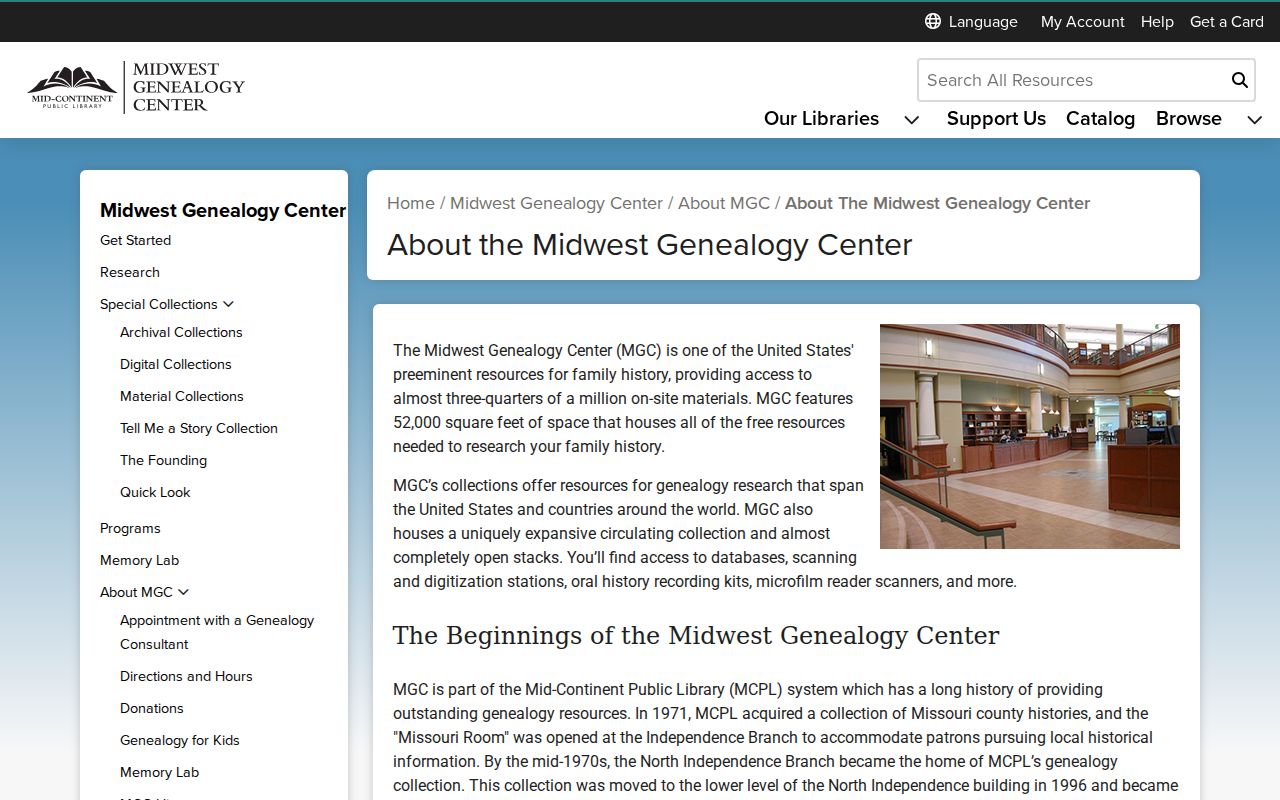
The collection page is a useful arrival point, but the screenshot does not establish a local directory run. Ask staff to check the catalog and shelves for Lee's Summit, Lees Summit, and older name variants, then request the exact volume and page before relying on any entry.
Lee's Summit City Directory Verification
The honest answer to “which years are online?” is that no official source reviewed identified a complete digitized Lee's Summit city directory series. No Polk volume numbers, local publisher, criss-cross span, or sample page was confirmed either. A city-directory collection is still useful, but it is not a license to fill the gaps with assumed years or marks. This is the important myth to avoid: an online directory hub does not mean every Missouri community has a searchable local volume.
For a shelf request, give MGC staff the spelling you have, the street or rural-route wording, a narrow date range, and any publisher clue from a family paper. Also mention whether the goal is a name listing or an address section. That information lets a librarian separate a city directory, telephone directory, newspaper, map, or county source without guessing.
Lee's Summit Directories Online
Missouri Digital Heritage's city-directory hub describes searchable digitized text and supports searches by name, address, occupation, and date. The runs documented there include Hannibal and St. Louis material, not a confirmed Lee's Summit volume. Use it for a Missouri comparison or a known place outside Lee's Summit, then return to MGC and the historical society for the local question.
The state repository directory lists the Lee's Summit Historical Society at 1923 SE Third Street, with local history, family, railroad, Civil War, and genealogy subjects. Its listed seasonal Saturday hours are 10 a.m. to noon, so call before visiting. The directory does not enumerate a city-directory series.
Note: A contact route can lead to private papers or local context, but only a described volume or archive item establishes what may be consulted.
Reading Lee's Summit Directory Entries
No viewable Lee's Summit entry was located in an official digital collection, so the fields below are a reading checklist, not a claimed local transcription. The Library of Congress directory guide explains that city and telephone directories can be alphabetical, address-arranged, or both. Capture the entry exactly as printed and photograph the volume's abbreviation key before deciding what a mark means.
| Name | Head-of-household or business name, copied with initials and spelling. |
|---|---|
| Household clue | A spouse or relationship notation may appear, depending on the publisher. |
| Occupation | A professional or business description may be present. |
| Address | Street number and street name, or an address-first listing in a reverse volume. |
| Status marks | Widow, owner, renter, or other marks only when the verified volume defines them. |
| Citation | Keep the directory year, page, and publisher with every find. |
- Criss-cross directory
- An address or street-order section that may point from a number and street to a name listing. Its presence must be checked in the local volume.
- Householder index
- A name arrangement focused on a household head or principal listing rather than every person at an address.
- Abbreviation key
- The publisher's explanation of symbols and shortened words. It should be copied with the entry, not reconstructed later.
Lee's Summit Directory Name Changes
Early local searching needs more than the modern city spelling. The city history dates the Town of Strother plat to 1865, the post-office name change to February 1868, and incorporation and renaming later that year. Search Lee's Summit, Lees Summit, and Town of Strother where an index accepts text. Keep apostrophe and middle-initial variants in the research notes as well.
The 1885 downtown fire is a separate historical anchor. The city history cites a Lee's Summit Journal account that says 25 buildings were destroyed. It helps date a newspaper or streetscape question, but it is not evidence that a county directory or people record was destroyed. The record loss was not verified and should not be inferred.
Newspapers Between Lee's Summit Directories
When an expected directory year is absent, MGC's microform and newspaper holdings offer a sensible fallback. Its research information names the Independence Examiner, Kansas City Star, Kansas City Times, and about 50 Missouri newspaper titles, though it does not publish a title-by-title Lee's Summit issue run. The city history also cites the Lee's Summit Journal for the 1885 fire account. Search a narrow date window around an address move, marriage, death, school event, or rebuilding date.
Newspaper notices can bridge an irregular directory sequence, but they are historical clues. Pair a clipping with a census page, deed, probate paper, map, cemetery entry, or original directory page when identity or address continuity matters.
Note: A newspaper mention can explain a gap between directory years, but it should not be treated as a full household list.
Lee's Summit Directory Map Evidence
The Library of Congress Sanborn map gives a precise September 1898 streetscape for Lee's Summit in two sheets. It can show a building footprint, street name, and adjacent use at that time. It does not identify an occupant by itself. Use it beside a dated directory, newspaper clipping, census line, or deed rather than treating the map as a resident list.
That pairing is especially helpful for a house-history question. A directory can place a named listing near a street, while the Sanborn sheet can test whether the structure or nearby block context existed in the same period.
Trace Lee's Summit City Directories
Once a verified volume is in hand, trace a household by preserving small, repeatable facts. Start with the exact name and page, then follow each confirmed directory year without forcing an uninterrupted sequence. Federal census releases supply dated household snapshots through 1950, while deeds preserve a separate property trail. Keep the historical shelf research separate from current parcel work, which belongs with the county records.
- Copy the name exactly and save the directory year, page, publisher, and any abbreviation key.
- Check the next confirmed volume for the same spelling, spouse notation, street, or business description.
- When an address section exists, look up the street and number, then compare the name section without assuming every volume is criss-cross.
- Pair the closest directory year with a public census schedule and preserve the enumeration district and sheet where available.
- Use a deed, obituary, probate item, or cemetery record to test whether a move, death, or estate event explains the change.
A disappearance can mean a move, a different spelling, a skipped edition, or an unlisted person. It is not enough to prove a death or vacancy. MGC's scanners, county microfilm, and archive catalogs provide access routes when the first shelf check does not resolve the question.
Lee's Summit Historical Collection Limits
The Missouri State Archives county-records search lets a researcher browse by county, office type, record type, keyword, city, and year range. It is not a universal name index. The state archive's microfilm and county records can provide another route for deeds, plats, probate, court, and county material after a local shelf check, while the historical society can offer locally focused context.
MGC's history also explains why Lee's Summit material can be regional rather than stored in a city portal: its genealogy service grew from a 1927 DAR book donation, a 1971 Missouri Room, and the 2008 MGC facility. Its research collection also supports interlibrary loan for many books, a practical fallback when staff cannot identify a needed local volume. That history is useful context, not proof of a particular local directory volume.